

Liquidity Bootstrap
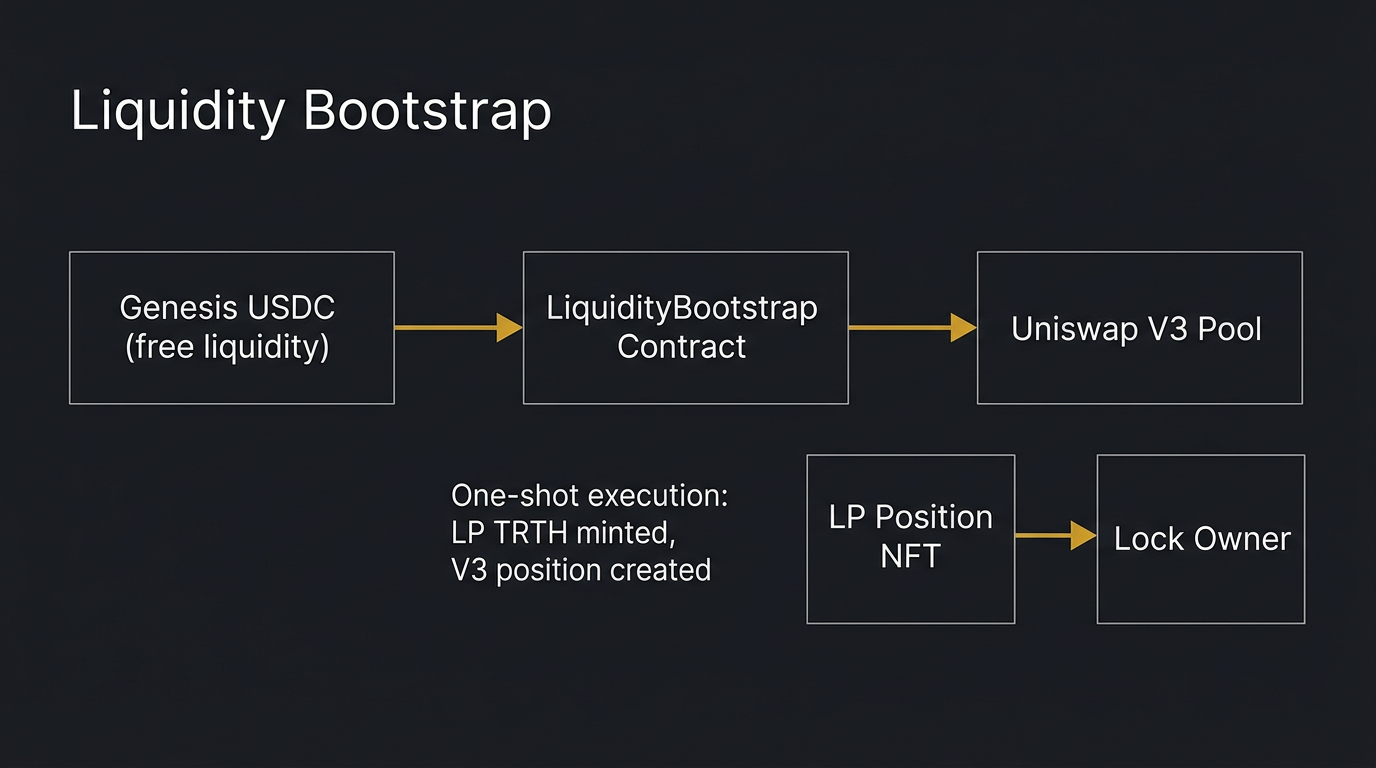
LiquidityBootstrap is the module that converts Genesis-allocated USDC into a single, deterministic Uniswap V4 position on Base. It is intentionally not a recurring market-making strategy: it is a one-shot seed of depth so the TRTH market opens with transparent, locked liquidity rather than ad-hoc treasury trading.
Funding source
Section titled “Funding source”The bootstrap uses USDC set aside from Genesis for liquidity, paired against a pre-funded TRTH allocation — 525,000 TRTH transferred to the bootstrap contract at deployment — that is consumed only for this one authorized deployment step. The design goal is credible initial liquidity — enough depth for price discovery — without an open-ended mandate to re-deploy or day-trade treasury funds.
Uniswap V4 pool and position
Section titled “Uniswap V4 pool and position”The flow creates or extends a Uniswap V4 pool between TRTH and USDC (or the configured quote asset). Concentrated liquidity means capital is deposited inside a tick range: liquidity is active near the chosen price and inactive far outside it, unlike full-range V2-style curves.
Position NFT and lock owner
Section titled “Position NFT and lock owner”V4 liquidity is managed via the Uniswap V4 PositionManager (using Permit2 approvals), producing a position NFT (an ERC-721). That NFT is the on-chain title to the position’s shares, fee accrual, and (if permitted) range updates. The protocol custodies the NFT in a protocol-owned vault (LiquidityPositionVault) or routes it to a lock owner — often a multisig or a lock contract — so post-bootstrap liquidity cannot be withdrawn casually.
One-shot discipline
Section titled “One-shot discipline”Because deployment happens once, initial price, fee tier, and tick placement deserve extra scrutiny. Operators typically align ticks with launch expectations and documented risk bounds so participants understand the opening market structure.
Together, Genesis USDC, authorized LP minting, V4 pool creation, and locked position NFT encode a clear initial AMM footprint for TRTH on Base.